Media Library Real-estate development — marketing operations 2026
Organised the way the business thinks, not the way the files arrived.
A project-organised store for photography, renderings and video that feeds the investor offering pages. Files dropped into the team's existing shared folder appear automatically, sized four ways.
The problem
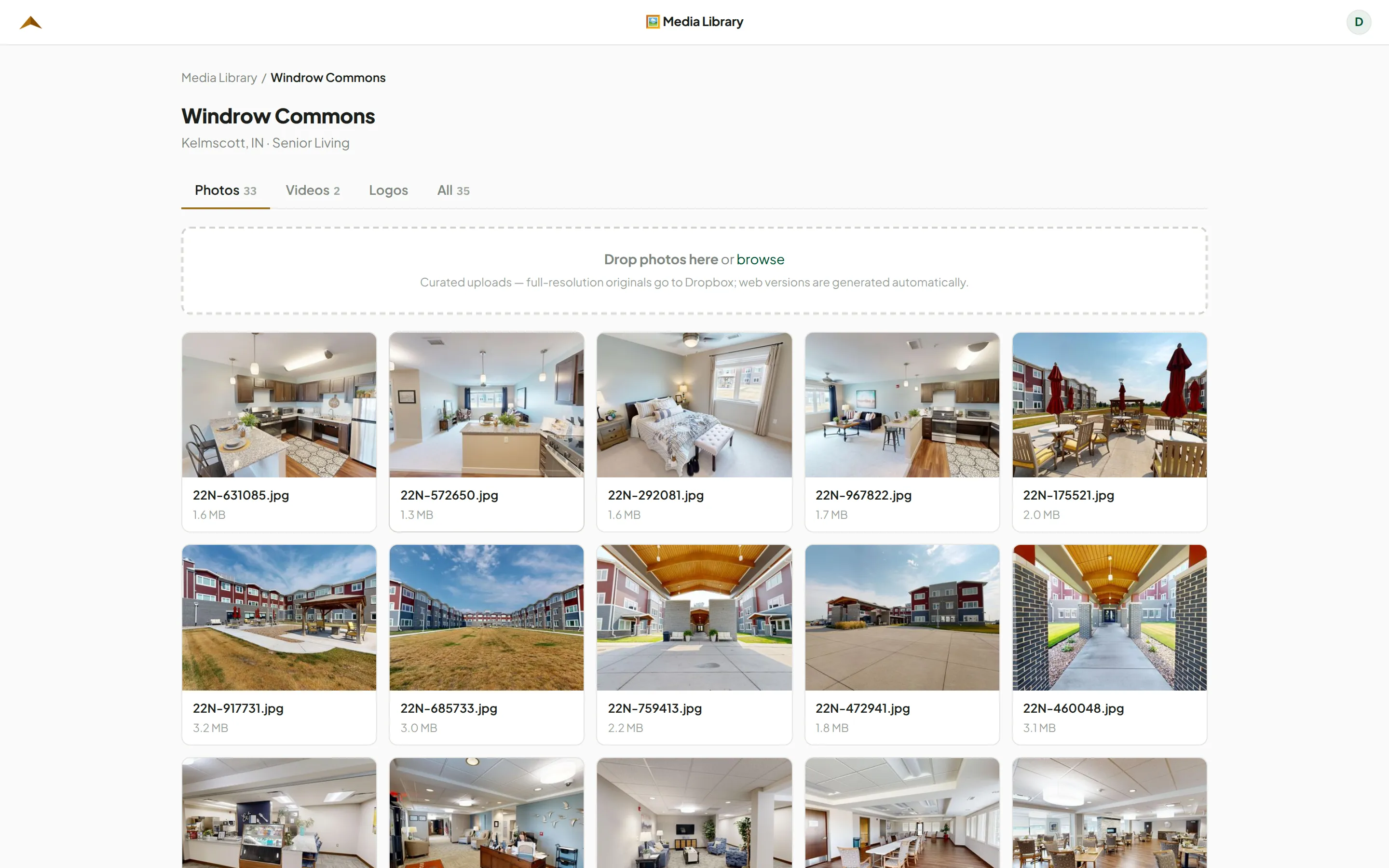
Every project a developer builds produces photographs — progress week by week, drone footage, renderings, site plans, finished interiors. Over a few years that is thousands of files in folders named by whoever created them. There was no index and no shared vocabulary, so finding a particular photograph depended on someone remembering where it was — and what came back was a camera original, far heavier than the investor pages it was wanted for.
It is organised the way the business thinks
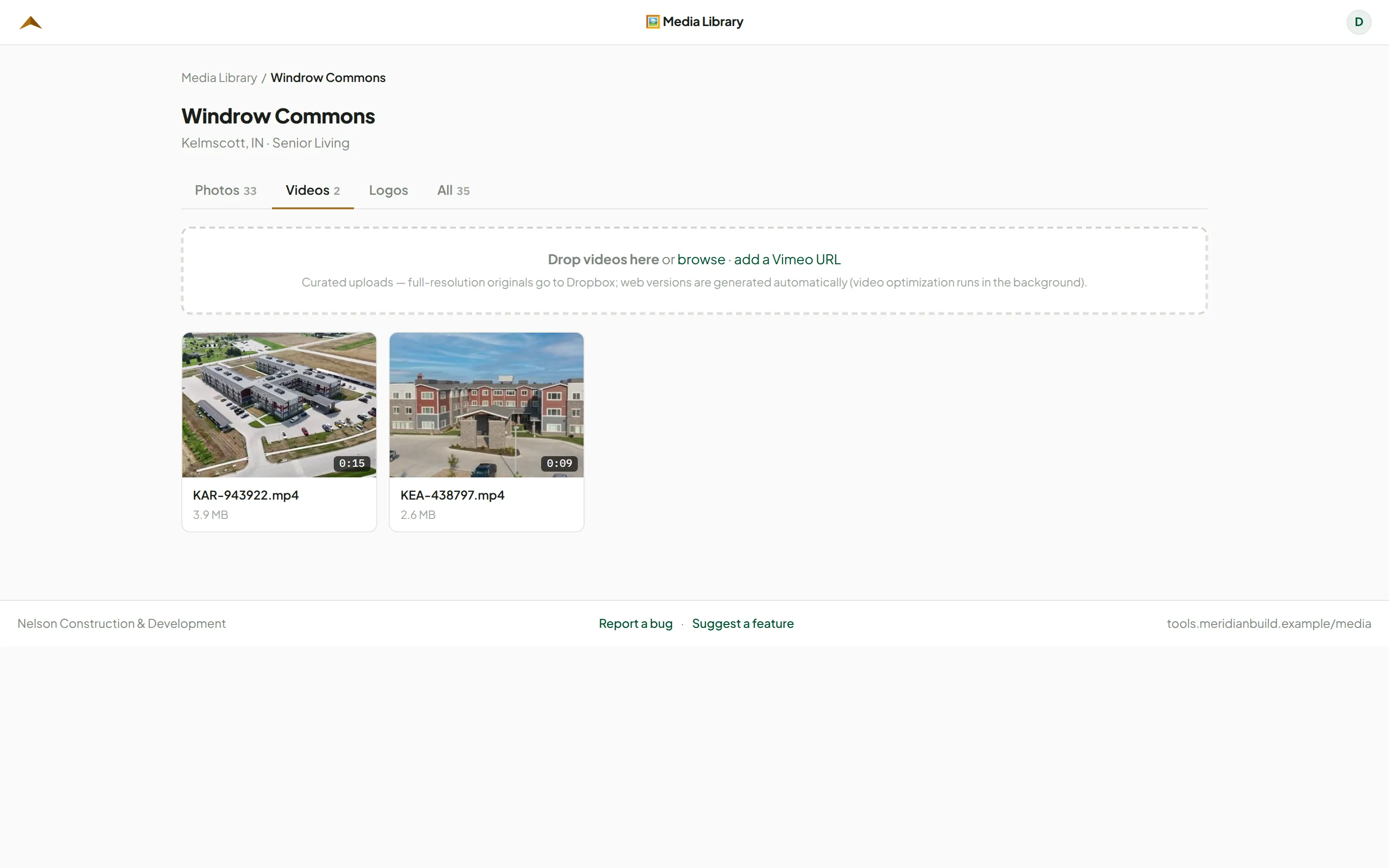
Assets belong to a project and are typed within it — photographs, video, logos — with counts on each, so what exists is visible before anything is opened. New files are dragged straight onto the project. Projects filter by asset class: senior living, behavioural health, multifamily, commercial, hospitality — the business's own vocabulary, not a taxonomy invented for a filing system.
Files were organised by who uploaded what, when. The library is organised by what it is of, which is how anybody looks for it.
Nobody had to change how they work
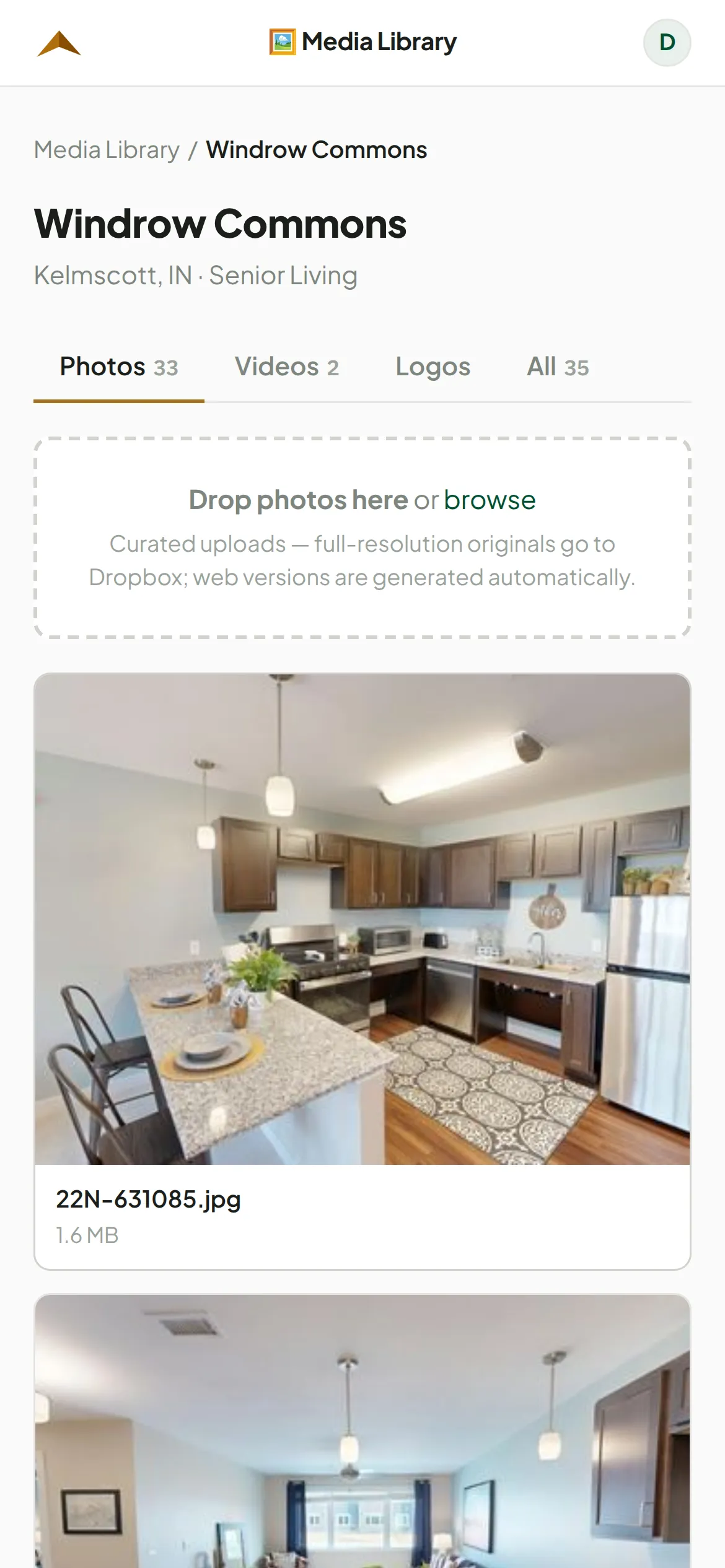
The team already used a shared file service and was never going to stop, so the file service stays the home of originals. A file dropped into the project folder is picked up immediately, with a sweep every fifteen minutes to catch anything missed; one uploaded through the library is written back.
The rest of it
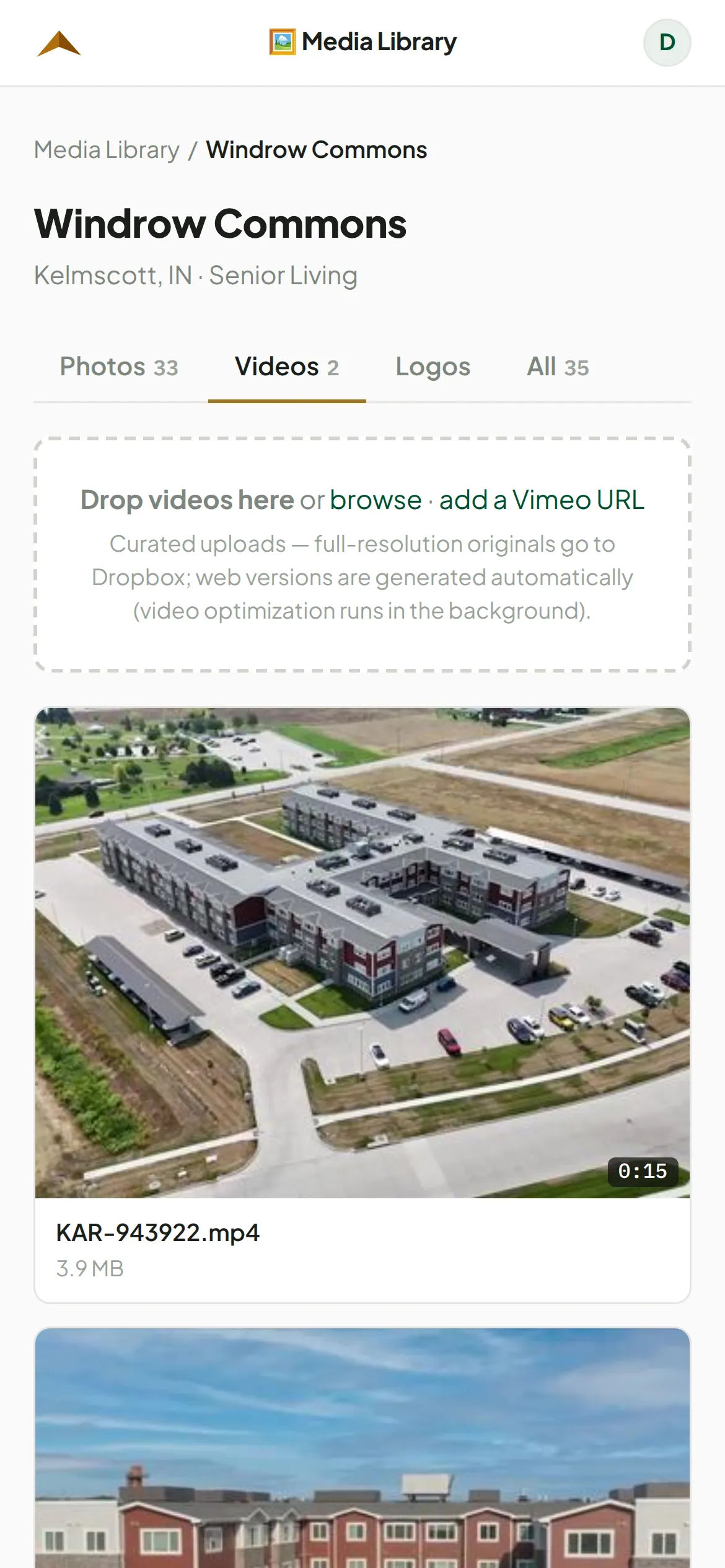
- Four versions from one upload. A thumbnail for the grid, a web version for a page, a web-native version of any video, and a poster frame, all made in the background. No page is optimised by hand.
- Addressed by key, never by path. Paths leak the structure of a business and can be guessed at.
- The original is never served. Only derived versions are reachable, whatever is asked for.
- It supplies the offering pages, and lives inside the operations record. The photograph at the top of an offering page comes from here, and the same component is mounted inside the operations record — one library in two places, so it cannot drift.
What changed
- Finding a photograph stopped going through a person. Everything is organised by project and kind rather than by who uploaded it.
- Nobody changed their habits. Two-way sync with the file service the team already used meant there was nothing to adopt.
- Pages stopped carrying camera originals. Four versions per asset, generated automatically, and originals are never served.
- Structure and originals both have one home. The library owns organisation and delivery, the file service owns the original file.
- The offering pages got a supply side. Imagery is catalogued once and reused everywhere, so a better photograph replaces a worse one in one action, not in six documents.