Ideas Board Construction and development — internal product 2026
Five votes a month each. Backing an idea has to cost something.
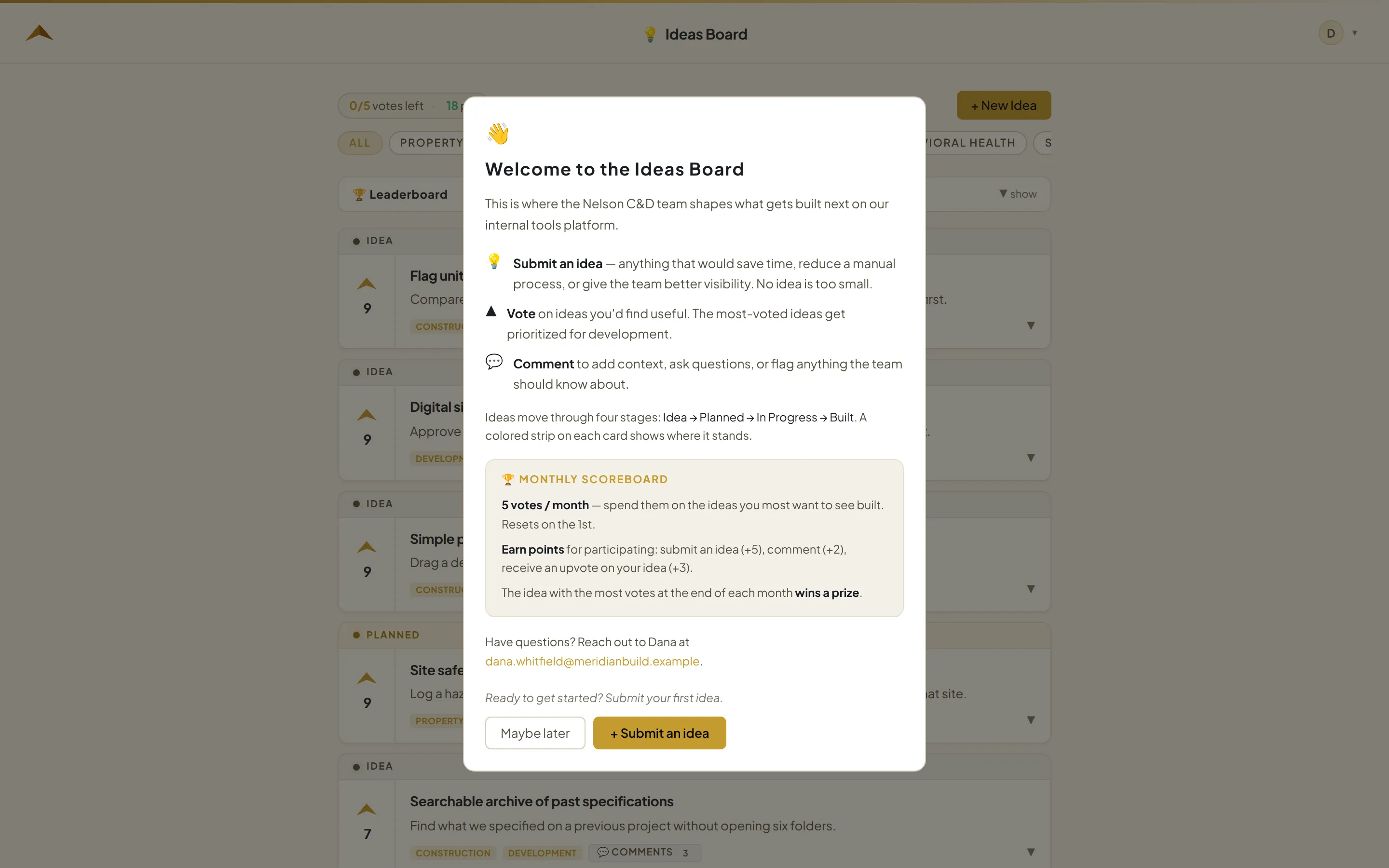
An internal board where staff propose tools to build. Five votes per person per month decide what gets built, and every idea shows its stage, so whoever raised it can see where it went.

The problem
Ideas about how the business runs come from the people doing the work, and they arrived in hallway conversations. There was no list, no way to tell whether an idea was popular or just loud, and no feedback to whoever raised one — so people stopped raising them.
Five votes a month, and that is the whole design
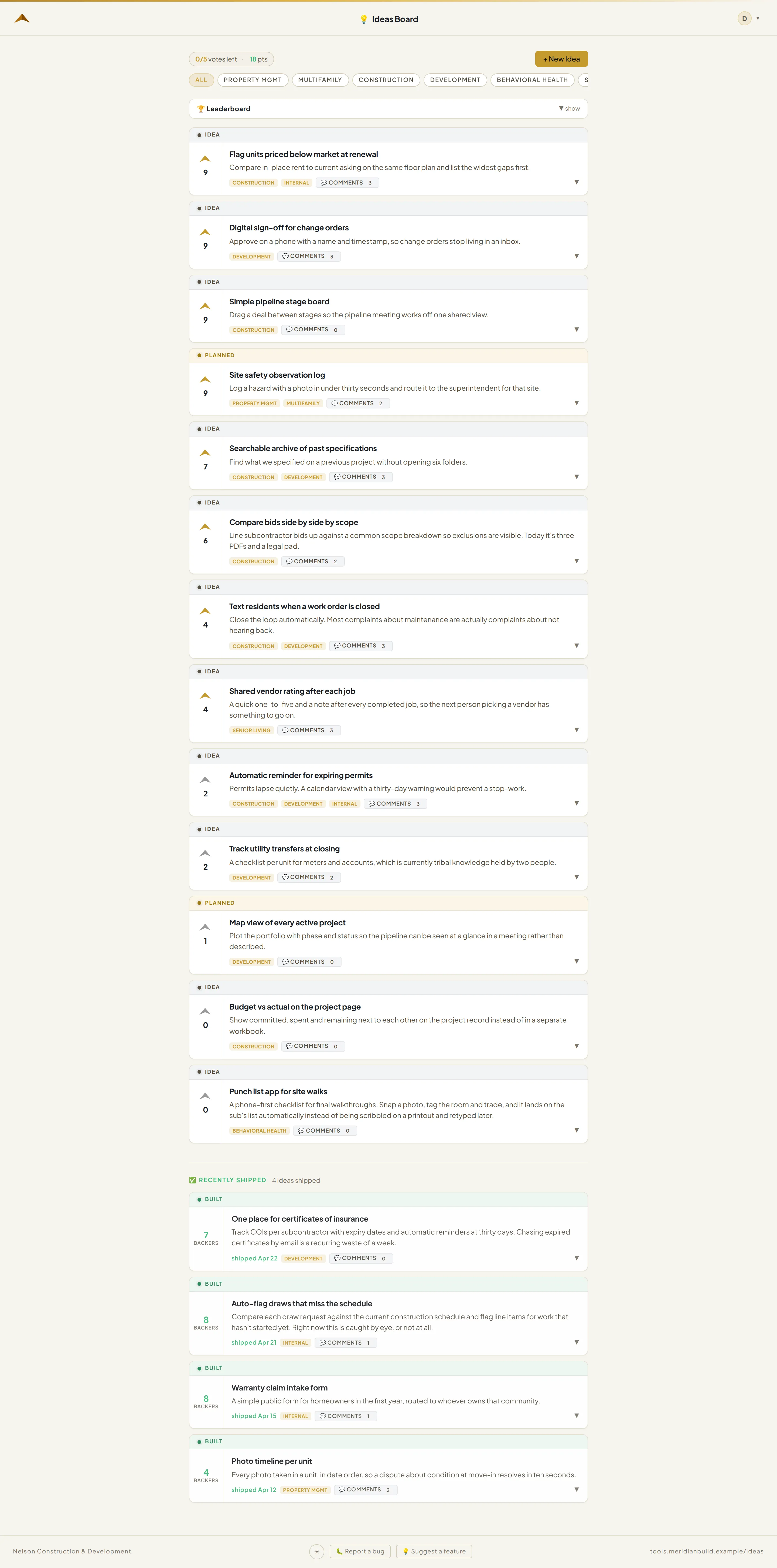
Anyone can post an idea, everyone can vote, and the board is one ranked list. The constraint is what makes it work.
Each person gets five votes a month. Five, reset on the first, and never for your own idea. Voting is one tap; pull a vote back and it returns to your budget to spend elsewhere. The budget sits permanently in the header, so you see what you have left at the moment you decide whether to spend one.
When votes are free, everything gets upvoted and the ranking measures how many people saw a thing, not how much anybody wanted it. With five, backing an idea means passing on another, so the top of the board states what the team wants most.
Every idea says where it got to
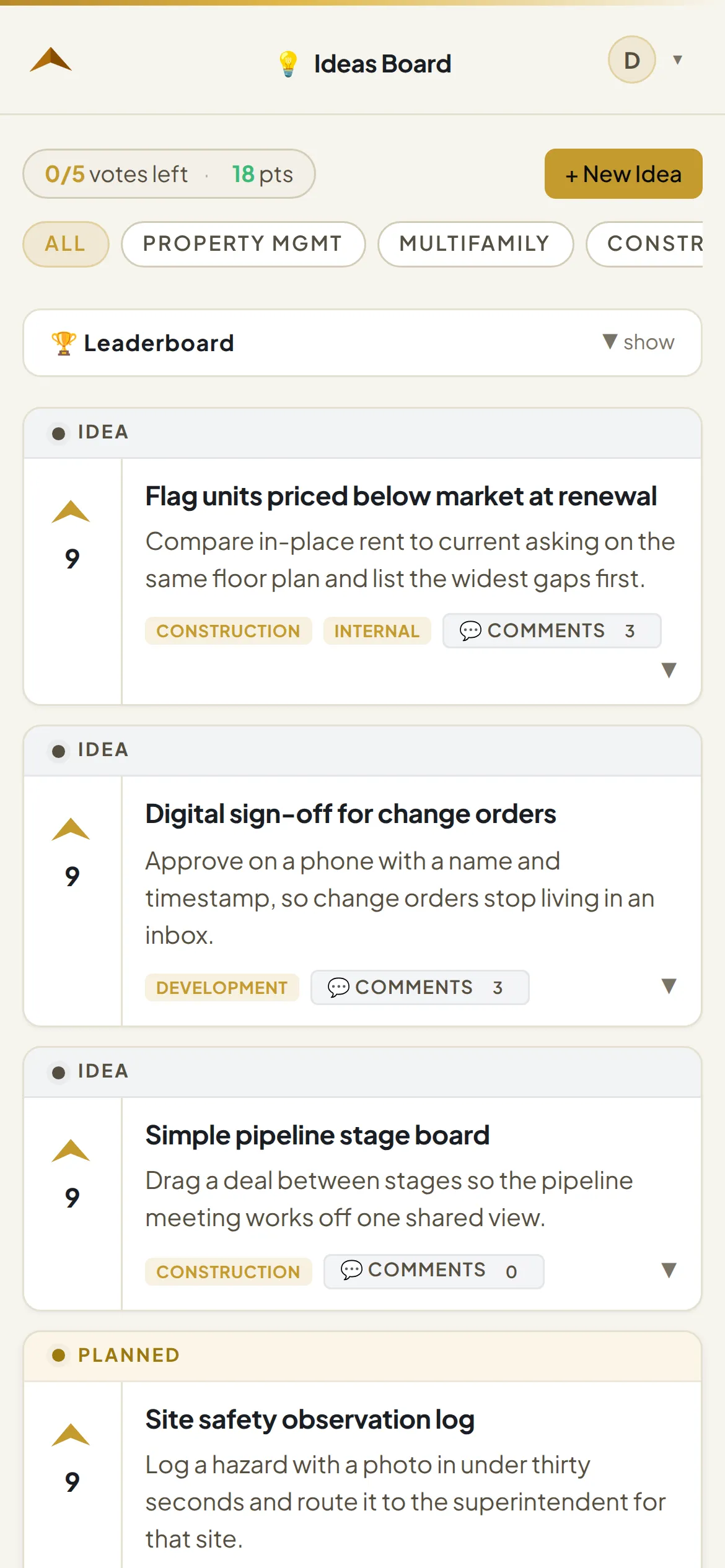
Ideas move through four stages — idea, planned, in progress, built — and the stage sits on the card as a coloured rail, permanently.
That is not a project management feature. It is the feedback loop: the person who suggested something watches it move without asking, and without anyone having to remember to tell them. Built ideas get their own card treatment, so completed work stays visible instead of disappearing into an archive. Nothing is deleted outright either — removed ideas can be restored.
The rest of it
- Writing it up is not the barrier. Appetite for writing was filtering out good thinking, so the compose form turns a rough sentence into a clean title and short description — keeping what you meant, inventing nothing you did not suggest. In the form itself, and optional, always.
- Taking part is rewarded, not just winning. Points accumulate for posting, commenting, having your idea backed and showing up at all. Standings run two columns, top ideas and top contributors, each switchable between this month and all time; the most-voted idea of the month wins a prize.
- The ideas come first. The leaderboard is collapsed by default, contributor email addresses are masked in the standings, and ideas and comments can both be posted anonymously.
- It comes to people. A short digest goes out every morning with the new ideas and new comments.
- Built for a phone. Cards reflow to a single column, category filters scroll sideways under a thumb, and text fields are sized so tapping into one does not zoom the screen.
What changed
- Ideas are written down in one place, filed under seven categories, none of them dependent on somebody remembering a conversation.
- Priority stopped being decided by volume. Five votes per person per month, non-transferable, no self-voting — so the top of the board is what the team most wants rather than what the most persistent person asked for.
- The feedback loop closed. Four visible stages on every card mean the person who suggested something sees it become planned, then built, without asking. Ideas raised on the board have become built tools.
- Contributing got cheaper. A rough sentence becomes a properly written proposal, so the barrier stopped being willingness to write.
- The board comes to people. A morning digest and a phone-first design, so participation does not depend on anyone remembering the tool exists.