The BeerGenius Hospitality — bars and restaurants 2011
Two hundred and fifty beers, and no way to choose between them.
A touchscreen beer browser for a bar carrying more than 250 craft beers. One inventory, maintained by the owner, drives the in-venue kiosk, the menu on phones and the bar's website.
The problem
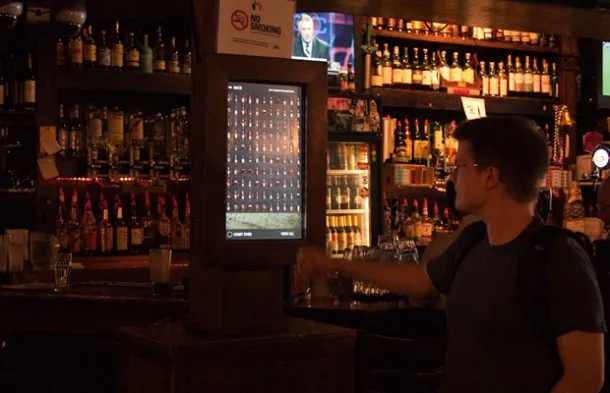
El Bait Shop, in downtown Des Moines, carried more than two hundred and fifty American craft beers. A selection that size defeats a printed list: 250 names are hard to read, and the list goes out of date the moment a keg blows. The question staff answered most often was what should I get?, and a useful answer depended on what the person already liked — which is exactly what a printed list cannot ask.
The selection is the interface
A touchscreen stands in the room, at the bar, where the question gets asked. It does not show a list. It shows the beer.
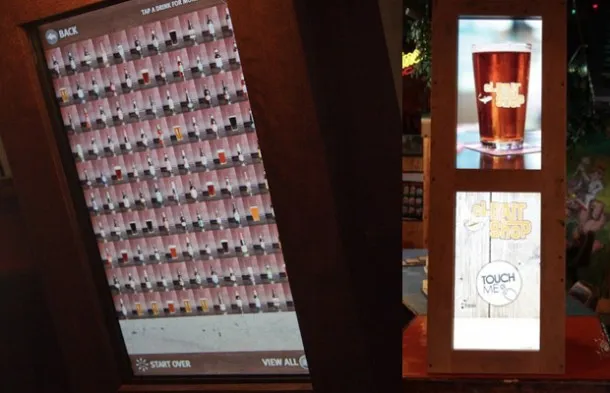
Every bottle and glass sits on the shelf as itself, arranged the way the wall behind the bar is arranged, so the thing on screen matches the thing in the room. Touch a beer to learn about it; touch a style to narrow the wall down to it. A list asks you to already know the name of what you want. A wall lets you point at something because it looks right.
It works for somebody who knows nothing, and for somebody who knows everything
The browser had to be useful to somebody with no vocabulary for beer and to somebody who knew the field well. Browsing is shallow and detail is deep: the top level demands no vocabulary, and every level after it rewards knowing more.
A beer opens to its name, what it tastes like and whether it is on tap, so it can be ordered by name rather than by pointing at a tap handle.
One inventory, three places it shows up
The bar's stock changes constantly, and any system needing updates in more than one place would be wrong within a week. A wrong menu is worse than a paper one.
A single backend, maintained by the owner, populates the in-venue browser, the beer menu on phones, and the bar's own website. Update the stock once and all three agree.
What changed
It launched at the bar on 17 February 2011, and broadcast and newspaper coverage followed.
The same approach shipped again as a wine browser, and again as a tablet menu for Americana across town — a full beverage list with food pairings, concept through build.
Film
Coverage
- KCCI 'Beer Genius' Helps You Find Your Favorite
- Des Moines Register Brothers aim Genius at Beer
- Silicon Prairie News Beer me! Fresk's Stefan Hansen tells the story behind BeerGenius